Events
Nobody should miss the encore over a flat battery
Charging demand at an event lands in a few hours. It gets planned beforehand, not during.
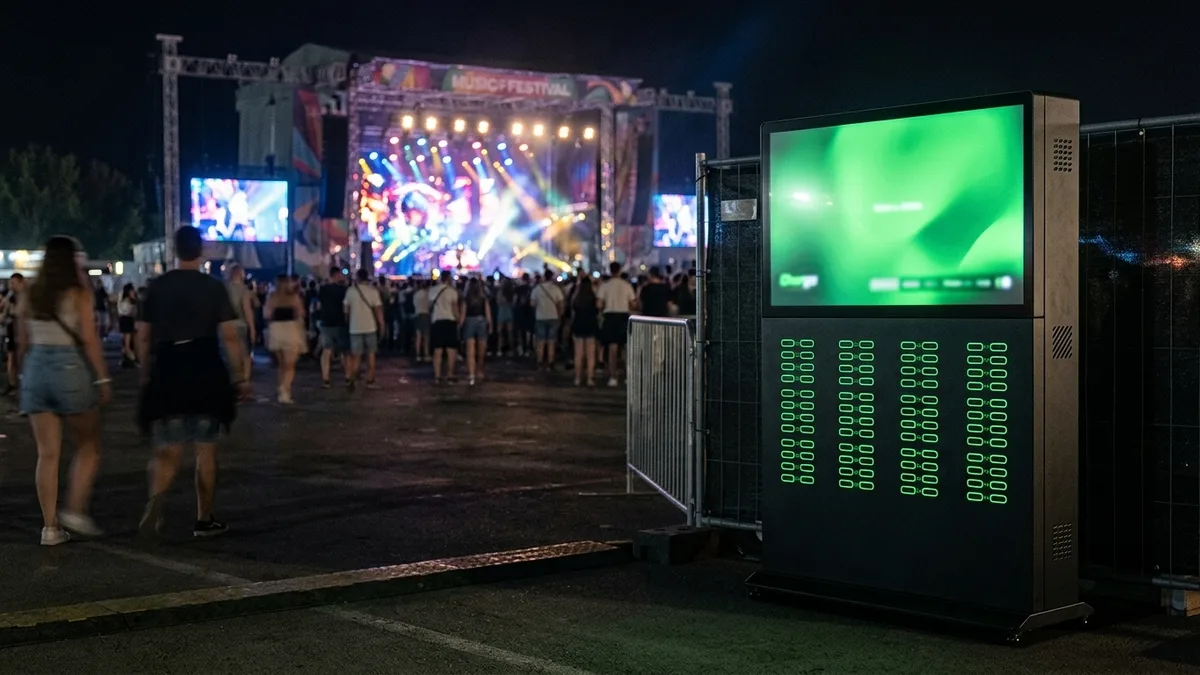
At an event the phone is the ticket, the map, the wallet and the meeting point all at once — and the whole charging demand lands in the same few hours. Chargo installs stations sized against expected attendance, runs them through the event and removes them at the end.
Key takeaways
- At events charging demand is a short spike, not steady consumption.
- The phone works as ticket, wallet and meeting point simultaneously.
- Sizing is calculated from expected attendance and duration.
- The arrangement is temporary: installed for the event, removed afterwards.
- Stations belong on circulation routes, not around the edges of the site.
The problem
Thousands of people leaning on their phones at once, running low, with no socket anywhere in sight.
High-capacity stations sized by attendance, positioned on the site's main circulation routes.
Benefits
What changes in your business
A safety issue as much as a convenience
Without battery, people can't regroup or book a ride home. Across a large site, that matters.
It protects on-site spend
If the event takes payment by phone or through an app, a dead handset is a sale that doesn't happen.
Sized against attendance
The number of stations is calculated from expected crowd and duration, not guessed.
Install and removal included
It goes in for the event and comes out afterwards. No permanent infrastructure to manage.
Use cases
- Concerts and multi-day festivals where the phone is both ticket and meeting point.
- Trade fairs and expos where exhibitors sell from their phones.
- Conferences and conventions with the agenda and materials on the handset.
- Sporting events with digital accreditation on the gate.
Event charging demand isn't steady — it's a spike
In a venue, charging demand spreads across the day. At an event it doesn't: everyone arrives together, uses their phone to get accredited, shoots photos through the first hours, and hits the back half of the day in the red — all at the same time.
That changes how you size it. "Put a station in" isn't a plan: you have to work out how many units are needed in the peak window, which is usually the last third of the event.
Where to place them on site
On the circulation routes: entrances, the food area, the paths between stages. The edges of a site look convenient for the build but are exactly where people don't go.
For multi-day events it's also worth having points near rest areas, where people sit down and take the opportunity to charge.
Why open returns matter more here
Across a large site, forcing returns back to the original point creates a pointless queue and a bad last impression, right when everyone wants to leave. With open returns, attendees drop the unit at whichever station is on their way out.
Frequently asked questions
How many stations does my event need?
It's calculated from expected attendance and duration. Send us those two numbers and we'll come back with the sizing.
Are they installed only for the event?
Yes. Event arrangements are temporary: build before, operation during, removal at the end.
Does it work for multi-day events?
Yes — and there, restocking and swapping units during the event is part of the operation.
Tell us about your event
With expected attendance and duration we'll come back with the sizing.