Transport
Charge that travels with the passenger
In a terminal a wall socket is the worst possible answer: it pins you down right when you need to move.
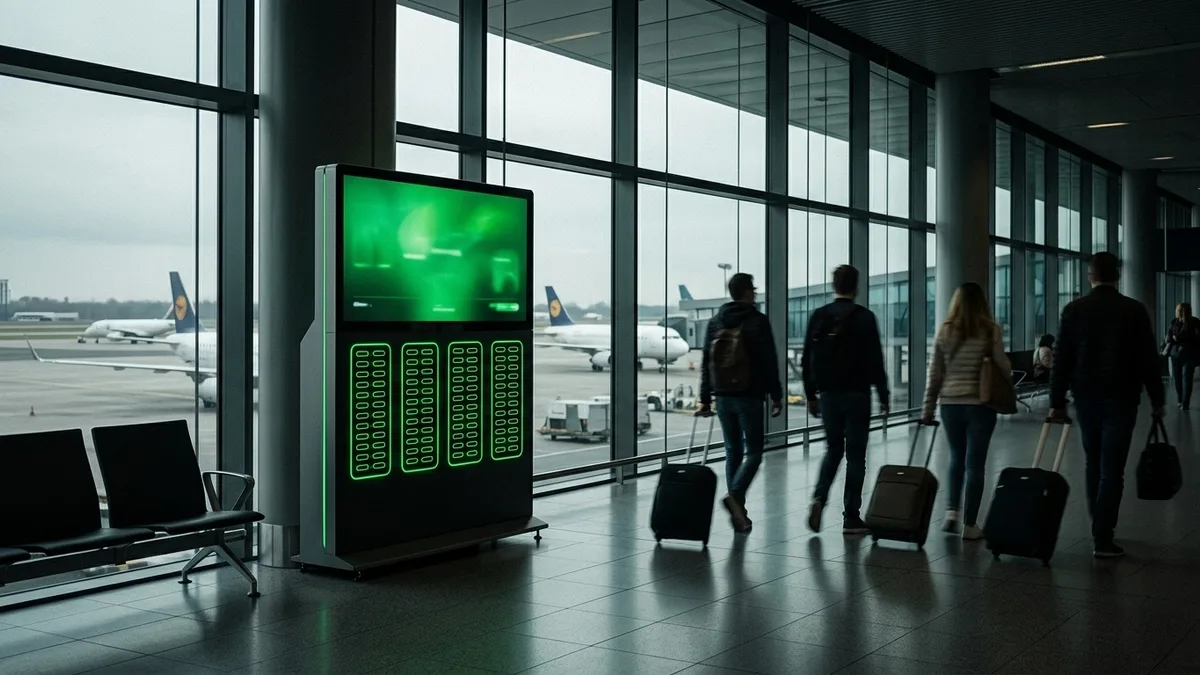
In airports and terminals passengers need their phone for the ticket, the gate, tracking the journey and getting around on arrival. Wall sockets are never enough and they force people to stay put. A Chargo station lets them take the charge to the platform, the gate or the coach.
Key takeaways
- In transport the ticket, the gate and onward travel all live on the phone.
- Wall sockets solve it badly: they pin passengers down right before they need to move.
- Passengers take the charge with them to the platform or the gate.
- Demand is high and sustained, so a high-capacity format fits.
- Open returns are essential for someone passing through who won't come back.
The problem
Passengers need their phone to travel, but charging it means standing still against a wall.
A high-capacity station in the concourse lets them take the battery to the gate and return it elsewhere on the network.
Benefits
What changes in your business
Passengers aren't anchored to a wall
They can walk to the gate with the phone charging in a pocket.
The digital ticket holds up
Boarding pass, gate QR and journey tracking all depend on a working handset.
It serves arrivals, not just departures
People landing need their phone for transport, accommodation and maps.
Built for heavy demand
The floor format is designed for sustained passenger flow.
Use cases
- Airports: departure lounges, check-in halls and the arrivals area.
- Long-distance bus terminals with extended waits.
- Train stations and interchanges with heavy footfall.
- Arrivals areas, where passengers land needing maps and transport.
A wall socket is a poor answer in a terminal
It's the solution that already exists in almost every airport, and everyone knows how it looks: people sitting on the floor around a pillar, cables across a walkway, and a quiet competition for the last free outlet.
The underlying problem is that it ties a passenger to a fixed point at precisely the moment they need to watch a departure board and be ready to move.
Departures and arrivals are two different needs
Someone departing needs battery for boarding and the flight itself. Someone arriving needs it to book a ride, find their accommodation and confirm they've landed — and they often touch down with nothing left.
Which is why it's worth covering both areas rather than only the departures hall.
Why the network matters more here
A passenger is, by definition, someone who isn't coming back to the same point. Open returns anywhere on the network are what make the service usable: pick up at the departure terminal, drop off somewhere else on arrival.
Frequently asked questions
Which format suits a terminal?
The floor unit, the highest-capacity one, because flow is heavy and sustained through the day.
Is it worth placing them in arrivals too?
Yes. Arriving passengers need their phone for transport and maps, and often land with a flat battery.
Can passengers return it in another city?
At any station on the network with a free slot. Actual coverage depends on which sites are live at the time.
Let's talk about your terminal
Tell us daily passenger flow and which areas you want covered.